
- Specifications
- Collection Specifications and Processing
- Network Connectivity
- IT related specifications
- Airflow
- Particle Recognition
- Concentrations
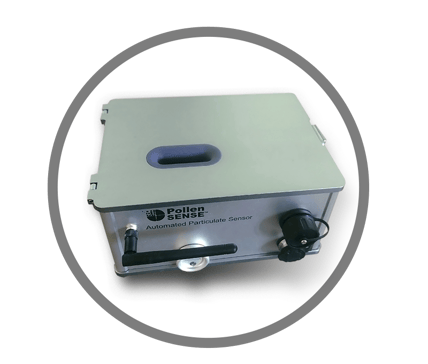
The APS-400 series particulate sensor is a spore-trap style collection device with an integrated imaging and recognition system. The system is designed to recognize particulates in the 1-100 micron range. The sensor requires a cloud computing backend infrastructure for configuration, augmented vision, and reporting, but can tolerate intermittent disruptions in internet service.
Specifications
|
Device physical dimensions |
(L x W x H) 8.2 x 6.1 x 4.0 in. (209 x 154 x 103 mm) |
|
Weight (gross shipping, net) |
7 lbs 13 oz (3.5 kg) |
|
Power requirements |
External outdoor adapter: 12VDC 3A: 3W idle, 8W Ave operating, 20W peak |
|
Network interfaces |
Internet access required: ~33 GB / month, 5Mpbs min, 10mpbs recommended Wireless (Wi-Fi): 802.11ac Ethernet – 10/100/1000Mb Optional: cellular bridge through Ethernet (no cellular support provided by Pollen Sense) |
|
Bluetooth interface |
Bluetooth 5.0 – via Particle Wise app on Google Play and App Store |
|
Temperature operation range |
Ambient 0-43C (-20-110F) |
|
Vibration |
Avoid vibration when placing the sensor. Choose a stable location away from rooftop fans or distant equipment that may transmit vibrations through the structure. If needed, use 5Hz dampening pads under the stand. |
|
Chassis features |
Material: Anodized aluminum Stainless Steel Latch – includes pad lock loop (padlock not included) Color: silver/gray |
|
Maintenance requirements |
~1-3mo: replace cartridge (depending on the density of airborne particulate matter) Periodic dust cleaning of interior and inlet Excepting the above, there are no user-serviceable components. |
|
Environmental & Climate |
|
Collection Specifications and Processing
|
Collection process |
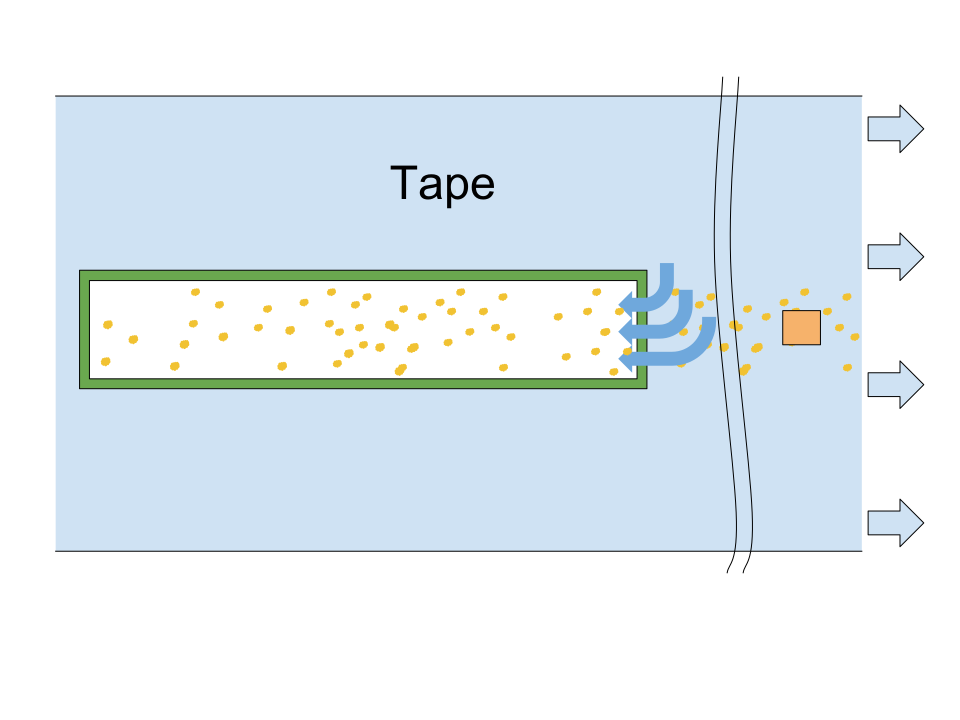
Particulates drawn via suction through laminar nozzle against adhesive sampling media tape |
|
Collection Efficiency |
0.978 *APS400 to APS400 Counted particles / Total particles in volume of air sampled. See more under APS-400 Calculation of Collection Efficiency **Comparison to Aerocell is in process Sep 10, 2025 |
|
Sampling Media exposure time |
Mean: ~15 minutes |
|
Field of view |
520 Microns wide (transverse to tape) |
|
Image sensor resolution |
1312 x 738 pixels or |
|
Nozzle aperture size |
14.4 x 2.4 mm |
|
Airflow speed |
18 Liters / minute |
|
Imaging process |
Multi-lighting, multi-focal, surface microscopy, with integrated image processing including:
|
|
Sampling Media advancing modes |
|
|
Continuous advancing process |
The sampling media is advanced adaptively depending on particle load. The varying rate optimizes tape utilization against overloading the tape (saturation). The time from collection to imaging (the latency) varies from approximately 30min to 70min. Note that adaptive latency will affect how long a cartridge lasts: between 30-84 days. Fixed latency is an option upon request. |
Network Connectivity
The APS is a cloud-first device. It does not connect to or accept connections from network devices on the local network. In an enterprise setting, the device is best put into an internet only DMZ, or otherwise isolated from any internal network (e.g. IoT VLAN).
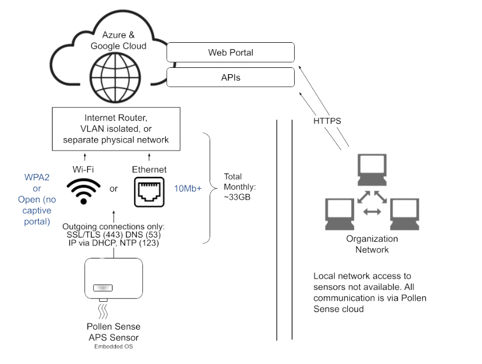
In order to startup, the device must have internet access, be assigned to a site, and be switched to “collecting” in the web portal or Particle Sense Mobile App (https://portal.pollensense.com).
|
Required Ports |
TCP: 443 (SSL), 53 (DNS), 123(NTP) |
|
|
Connections & Firewall |
Outgoing connections only; no port forwarding needed |
|
|
Wi-Fi setup |
via Bluetooth using Particle Sense app |
|
|
Total traffic |
~33 GB / month **Optional compressed image setting upon request. Reduces data to approx 13GB / Month with some identification loss. |
|
|
Bandwidth |
5Mpbs minimum, 10mpbs recommended OS updates require higher bandwidth speeds in order to download successfully. |
|
IT related specifications
|
Operating System (OS) |
Custom embedded Linux |
|
Storage |
32GB OS / system industrial micro SD (TF) card 32GB Data micro SD (TF) card Copy-on-write filesystem is used |
|
Partitions |
Dual OS partitions with auto-failover |
|
Hardening |
|
|
Connections (all 443 outgoing for normal operation, exceptions noted) |
|
Airflow
The APS-400 regulates airflow via RPM monitoring, which is sampled and adjusted every 500ms. In the event that the RPM deviates by more than 300RPM (4.3%) from the expected 6900 RPM, a sensor status alert is issued with an indication of the actual vs expected. In any case, the actual measured RPM value is stored with each frame rather than assuming the configured value.
When computing particulate concentrations, the measured RPMs are converted to liters per minute based on calibration measurements performed at our office in Provo, Utah, USA. Because these calibrations are based on an altitude of 1387 meters, and were performed at 23.33 Celsius, variations in altitude, temperature, and to a small extent, barometric pressure may have an effect, as described in the following chart:
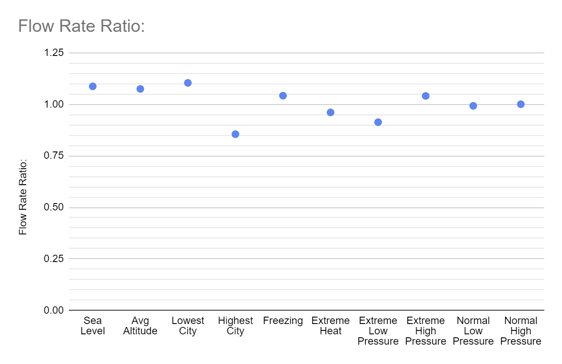
The following barometric pressures are assumed by this chart (in Pascals):
|
Record High |
Record Low |
Normal High |
Normal Low |
|
108480 |
87000 |
101325 |
100000 |
Extreme Heat = 48 Celsius, Freezing = 0 Celsius
The following altitudes were used:
Particle Recognition
|
Method |
Based on location and time of year, a dynamic set of the following are employed:
|
|
Detector level classes |
|
|
Classifier level classes |
Depends on the detector class, location, and season. Pollen classes are grouped under:
Mold and Other sub-classes are grouped directly under the detector level class. |
|
Machine Vision Architecture |
Convolution Neural Network (CNN) detectors and classifiers |
|
Vision Processing Location |
On device and in-cloud |
|
Training method |
Lab captured samples + field samples + user suggested corrections |
|
Minimum feature size |
2.0 microns |
|
Maximum feature size |
300+ microns |
Concentrations
Concentrations are calculated on a per frame basis, by taking the total volume of airflow through the nozzle while that frame was exposed to airflow in the area of the nozzle, and factoring in the ratio of that frame’s area, to the total nozzle area.
After running computer vision for the frame, the raw frame information, which includes:
-
CollectedAt time, which represents the end of the window of time in which the frame was exposed to the collection nozzle
-
ExposureMinutes which represents the total time the frame was exposed to the collection nozzle.
-
Set of tags, which includes size and position of each particle
-
For each tag, a set of possible categories with probabilities
This information is then normalized such that:
-
The highest scoring possible category is selected
-
Low scoring categories are only represented at a higher taxa (e.g. if vision suggests a 1% chance that a given pollen particle is Artemisia, the particle is counted only at the level of Pollen). In this way, the super-category counts may not strictly represent the sum of the parts
Once normalized, the frame and tag information is partitioned into hour groupings, prorating as necessary if a frame is split over hours. Particle counts by size, using a 1 micron resolution histogram, are also stored for each hour.
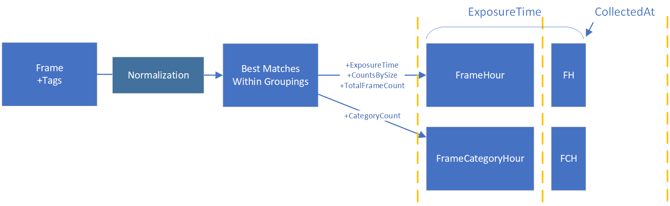
From here, a set of “rollups” are updated, which represent the average concentrations for each of the following time intervals:
-
Hour
-
Day
-
Week
-
Month
Computation
The computation is based on using direct counts (over exposure time) if counts for the category are sufficiently high. Because particle counts within a given category tend to co-vary with changes in the total particle load, if counts are low for a given category, inference is attempted based variation of total parts within a time window, but only based on strength of correlation.
Definitions:
-
Collection Efficiency: Ceff - This represents the efficiency of the collection process. This is assumed to be 1.
-
Probability: Pr - This represents the probability of the particle being within the given category. Because each particle is assumed to be whatever the highest probability vision assigns it, this will be 1.
-
Exposed Minutes: Emin - This represents the duration of exposure in minutes.
-
Airflow Cubic Meters per Minute: Vspm - This represents the rate of airflow in cubic meters per minute, inferred from the sensor’s measured RPM fan speed at time of capture.
-
Square Millimeters per Frame: Fmm2 - This represents the area in square millimeters per frame.
-
Square Millimeters per Nozzle: Nmm2 - This represents the area in square millimeters per nozzle.
-
Total parts: P - How many parts to count for the given particle.
-
Parts Per Cubic Meter: Pm3 - This is the total inferred parts represented by a given particle for the exposure time of the frame.
-
Direct Particles per Minute: DirectPPM or CategoryPPM - Measured count for a given category for the time period, over the total number of exposed minutes for the period.
-
Inferred Particles per Minute: IPPmin - Prediction for a given category based on the variation from the mean for the total particle count, applied to the category
-
Inference time interval: It - The number prior hours considered for inference
-
Correlation coefficient: CorrCoefficient - Pearson correlation for the category over the inference time interval, relative to the total particle count

- Direct Weight: Dw - If particle count for the category is above a threshold: 1. If below a threshold: 0. Linearly interpolated between thresholds

- Inferred Weight: IW - The positive portion of the correlation coefficient, superseded by the direct weight


-
Inflated Direct Weight: InflatedDirectWeight - The amount of direct weight to use, using direct measurement when inference is weak.
1 - IW -
Raw Inferred PPmin and Raw Direct PPmin - The inferred and direct particles per minute for the category before applying weights
-
Conversion factor: CF - The factor to convert from particles per frame minute to particles per cubic meter

-
Confidence: C - The total confidence (0-1) for a given rollup based on the weights and the total amount of reported intervals. For instance, if one hour has been reported in a day period, the confidence will by 1/24th of the hour’s confidence.

Total particles per minute for a given particle are thus:

And:

This is then converted to concentrations as follows:
